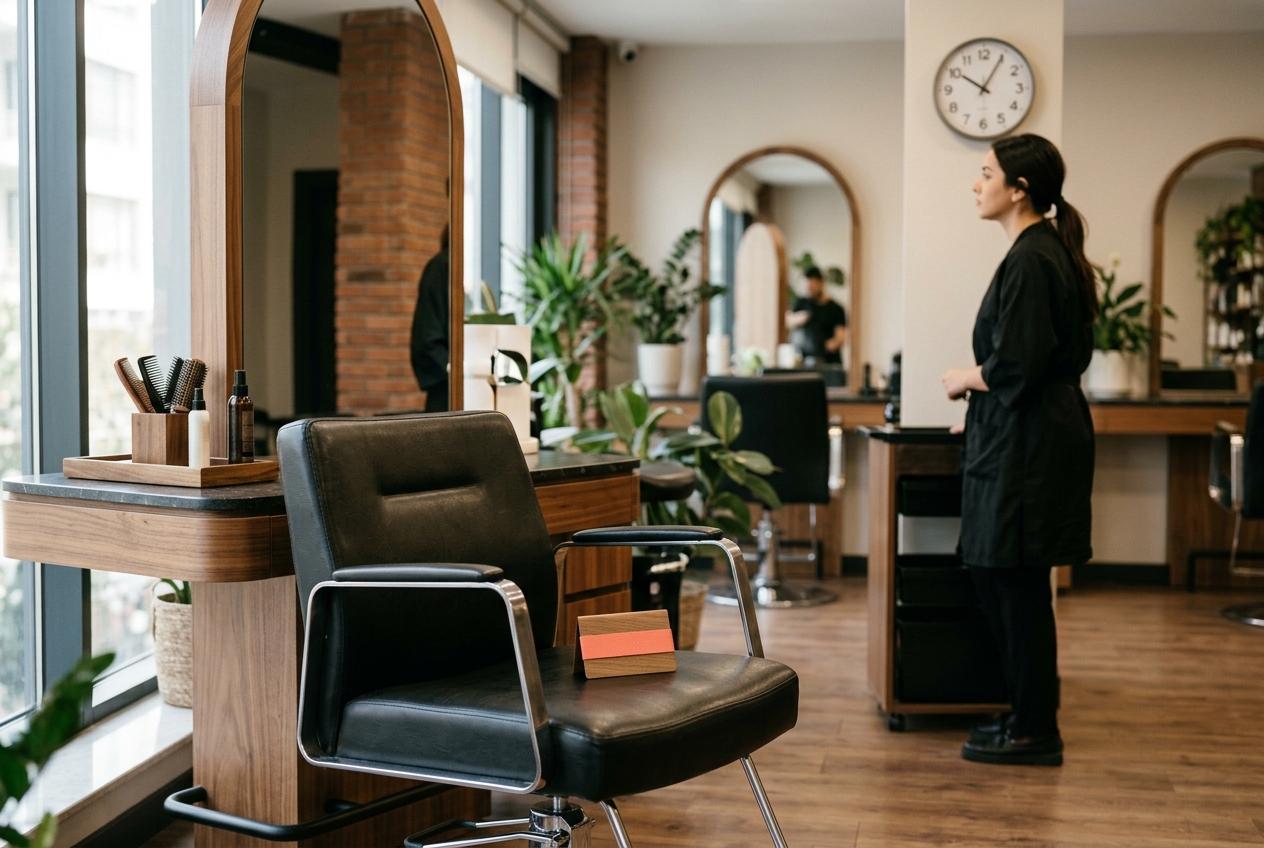
It's 2 p.m. There's a name written next to that slot in your appointment book, but the chair is empty. They're not picking up the phone, not replying to messages. You could have given that hour to someone else — in fact you turned two people away because this name was supposed to show up. Now the revenue for that hour has vanished, and somewhere inside there's a nagging thought: "Did I do something wrong?" Sound familiar?
That's exactly why we wrote this. Because it isn't only about being angry. You are angry, but you don't want to lose that client either; maybe they've been coming for three years, maybe they're a neighbour you know. You get stuck between "Should I message them? What would I even write? Would it be rude? Or should I just say nothing and swallow it?" Below we'll talk through that dilemma and give you WhatsApp messages you can genuinely copy and paste, sorted by situation. No flowery lines, just something to keep handy.
When an appointment goes empty, the money isn't the only thing you lose. You blocked that slot, you turned another client away because you were "full," your staff maybe waited around for that job, you got everything ready. So a single no-show leaves three or four invisible losses behind it. It's completely normal for that to bother you — it isn't a weakness.
But here's another truth: most clients aren't coming — or not coming — to upset you. They forgot, work got in the way, a child got sick, they were stuck in traffic, they put it off thinking "they'll call anyway." There's usually no bad intent. That's exactly why, instead of reaching for the stick in your first message, setting a tone that keeps the door open makes you look less harsh and raises your chances of winning that client back. Setting a boundary and slamming the door are not the same thing.
Before we get to what to write, here's the logic sitting underneath every message. Keep these in mind and you barely even need the templates:
There's no need to be harsh with this client. A first slip can happen to anyone. Your aim: send the message "I noticed, but I'm not offended." Keep the warmth while drawing a fine line so they don't get too casual next time. You can copy the message below straight off:
"Hi [Name], we were expecting you today at [2:00 p.m.] but you couldn't make it — I hope nothing was wrong. 🙂 If you'd like to set up a new day, we'll gladly open your spot again. Take care, [Salon Name]."
If you'd prefer something even shorter and more everyday:
"Hi [Name], you couldn't make your appointment today — hope everything's okay. Let me know when you're free and we'll find a new day. Take care."
This is the easiest and the most valuable. If the client has already written "sorry, this and that came up," they've done their part; they've shown respect. Replying to someone like that with an ice-cold "okay" is the biggest mistake you can make. Meet their gesture, because this is very likely the client who will come back.
"Not at all, [Name], I hope everything's better now — your health comes first. Don't worry about a thing, I hope it all sorts itself out. Just tell me a day that suits you and we'll set up a time that works for you. Take care of yourself."
If they let you know early on the same day, add a thank-you too; this small touch makes a difference:
"Thanks so much for letting me know, [Name] — that way we could put the slot to good use. When are you free for a new appointment?"
Now for the genuinely hard one. If the same person stands you up a second or third time, it's no longer a "mishap," it's a habit. Keep up the understanding tone here and the client won't take you seriously. Your aim: stay courteous but set a clear rule. Say "this can't go on" without being rude.
"Hi [Name], you couldn't make your appointment again today. We love working with you, but since we set those hours aside for you and don't take other clients in that time, it's putting us in a tricky spot. From now on we'll ask for a small confirmation on the day of the appointment — I hope that's understandable. If you'd like to set up a new day, we'd be glad to."
If you now want to introduce a rule like a deposit or prepayment, the gentlest way is to say it without blame, under the umbrella of "we do this for everyone":
"Hi [Name], to keep appointments from going empty during our busy hours, we now take a small prepayment from all our clients when they book; if you can't make it there's no problem, and when you come it's deducted from the total. We'd love to have you at your next appointment too."
The subtle trick here is this: you pin the rule on the business, not the person. You're not saying "I don't trust you," you're saying "this is just how our system works." That difference is the line between losing a client and keeping one.
Now for the crux of it. Every one of these messages is about limiting the damage after it's already happened. But the biggest part of the no-show problem doesn't come from bad intent — it comes from forgetting. Someone books three days out, life gets in the way, and they completely forget the day. Then you're the one staring at an empty chair, feeling let down.
This is exactly where an automatic reminder message — sent to the client the day before and a few hours before the appointment — largely solves the problem before it happens. Instead of typing "see you tomorrow at 3" one by one, the system does it for you. The client remembers, lets you know in advance if they can't make it, and you can open that slot up to someone else.
We had exactly this pain in mind when we built SalonSync. Once your appointment book is digital, reminder messages go out automatically over WhatsApp and SMS; you do nothing extra. The "no-show" problem never hits zero, but it drops noticeably — because most people were just waiting to be reminded. And your need to write the messages above naturally shrinks too.
The best time is about half an hour to an hour after the appointment time. If you message the instant they miss it, they might still be on their way; if you leave it too long, you'll be more wound up and slower to fill that slot. A short, calm message that leaves the door open always gets a better response.
Instead of slamming the door, try a boundary first: ask for confirmation or take a deposit. Most clients will either straighten up when they see the rule or quietly bow out. Either outcome works for you: you don't come across as harsh, and you stop bleeding money. The decision stays with the client; you've simply set your business's rule.
Not if you apply it to everyone the same way, framed as "this is just how our system works," because it never feels like personal distrust. A client who genuinely intends to show up won't mind a small prepayment. The ones who mind are usually the ones inclined to flake anyway. So the practice doubles as a filter.
Largely yes, because a big share of no-shows come down to simply forgetting. A reminder the day before and a few hours ahead makes the client go "oh right, I have an appointment." If they can't make it, they let you know in advance and you rescue that slot. And since it's automatic, it takes no extra effort from you.
With SalonSync, appointment reminders go out automatically over WhatsApp and SMS, so no-shows drop from the start. Try it during free early access — 0% commission, flat pricing.