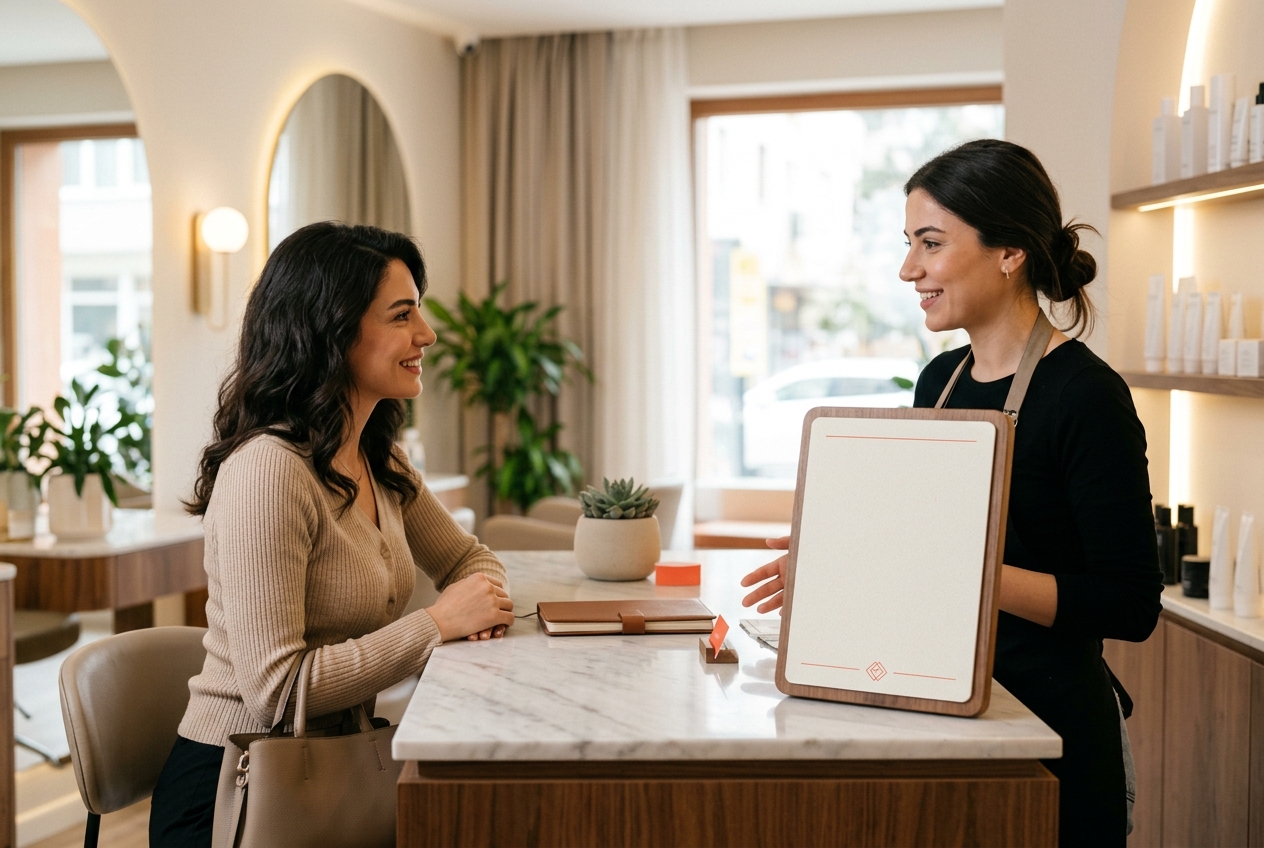
The colour supplier put their prices up. The electricity bill went up. Rent isn't even worth mentioning. So you finally had to reach for the price list and nudge a couple of lines upward. Then the moment came: a client who's been coming to you for years settled into the chair, heard the total, and their face changed. "Oh, but it used to be cheaper." That sentence felt like it echoed around the whole place. And you couldn't quite say anything back. You printed the receipt, said thank you, walked them to the door. And something inside you sank.
Here's the bitter part: you didn't con anyone. You're not pocketing anything extra. You simply moved your price closer to reality so you could cover rising costs. Yet that guilty feeling just won't shift. In this piece we'll try to ease that feeling a little, and talk through how to explain it to the person in front of you with respect, without shrinking. Three concrete moves, not scripted lines, but real words you can use at the chair the very next day.
Silence that voice in your head. The one that says "I'm ripping my client off" is lying. You're not ripping anyone off. If a tub of colour has doubled in price over a year and you keep charging the same money, that difference is coming out of your own pocket. So you're not giving the client a discount, you're writing yourself a loss.
The biggest mistake a small business owner makes is treating a price increase as something to apologise for. If you start with "I'm so sorry, we had no choice," the other person naturally assumes you're the one at fault. But this isn't a crime, it's a business decision. The greengrocer raises prices, the supermarket does, so does the café you go to. Nobody expects an apology from them. Nobody should expect one from you either.
Don't forget: a loyal client chose you not for your price, but for your work and for how you make them feel in that chair. Explained with the right words, most people understand a reasonable increase perfectly well. The person who sulks usually isn't upset about the increase itself, but about the way it was delivered.
What really angers a client isn't the number, it's the shock of hearing the total as they're getting out of the chair. Caught off guard, people go on the defensive. So the first move is simple: mention the increase before you start, not on the bill.
Saying the price in advance isn't weakness, it's the opposite, it's a sign of confidence. A line like "By the way, because material prices have gone up so much we've updated the list, colour is now this much, just so you know" completely removes that ice-cold moment when the total appears. When people are informed, they feel respected.
Put the new price list somewhere visible, or make it easy to show on your phone. Give a quick reminder when booking. The aim is that nobody ends up feeling "they raised the price behind my back." Transparency is the strongest antidote to hurt feelings.
When a client says "but it used to be cheaper," there are two wrong reactions. The first is to bow your head and say "you're right, what can we do"; that makes you look meek. The second is to get defensive and snap "everyone's raising prices, why shouldn't I"; that drives the client away. The right path is the middle of the two: explaining calmly, clearly, and truthfully.
You don't need to drown them in figures, one honest sentence is enough. Saying "You're right, last year it was; but since then the box of colour I use has almost doubled, so I had no choice but to adjust" takes you out of the guilty seat and shows you're in the same boat. The client already sees their own supermarket receipt, they know life has got more expensive.
The golden rule here is: explain the cost, but don't plead. Not a "please understand me" tone, but a "this is the situation, I'm running a shop in these conditions just like you" tone. One tradesperson understands another, and a client understands the professional whose effort they can see. Knowing your own costs clearly is what keeps your voice steady in this conversation, because you're not making it up, you're stating a fact.
Nobody sulks about an increase, they sulk about "not getting their money's worth." A person who feels they paid the same money for one thing less will feel short-changed. So the strongest move is to never leave the increase on its own: put a visible value alongside it.
This doesn't mean refurbishing the whole salon. Small but noticeable touches are enough. A cup of tea or coffee, a little aftercare tip once the service is done, booking the next appointment right there and then, honestly telling them what genuinely suits their hair. If the client gets out of the chair thinking "prices went up a bit, but this person really knows their craft and does it justice," you've won.
You can also make a small gesture for a loyal client: "We've worked together for years, prices did go up, but let me do one more at the old rate and we'll switch after that." That single sentence binds that person to you for years more. Even when an increase is unavoidable, softening the transition is in your hands. An increase delivered with value stops being an increase and becomes a natural part of the service.
Everything we've talked about so far has one precondition: genuinely knowing how much you need to raise your prices. Most owners set an increase by thinking "it's probably about this much," by glancing at the shop next door, or with a back-of-the-envelope sum. The result: either you raise too little and stay in the red, or you raise too much and drive the client away unfairly.
Yet the real cost of a service to you is knowable: materials, time, the share you use. When you see this clearly, you can decide with ease "this service needs this much of an increase, and this much is too much." The confidence in your voice comes from here; you stand behind the number because you know you didn't make it up.
This is exactly where a tool like SalonSync quietly earns its keep. Which service brings in how much revenue, what you really keep at the end of the month, which service is running at a loss; you see these with a report, not a guess. The decision is yours, but at least you're not shooting in the dark. The right price both keeps you standing and stops you being unfair to the client.
Definitely in advance. What really makes an increase annoying is the surprise shock of hearing it at the till. Saying "we've updated our list, this service is now this much" when booking or before you start completely removes that unpleasant moment and leaves a respectful impression.
Don't apologise and don't get defensive. Calmly state the truth: "You're right, it used to be; but the product I use has almost doubled since then, so I had no choice but to update it." That sentence takes you out of the guilty seat and shows the client you're both facing the same pressures.
Still raise the price, but soften the transition. A small gesture like "we've worked together for years, prices did go up, but let's do this one at the old rate and move over next time" will bind that person to you for years more. Adding a little value to the service also stops the increase from feeling bare.
Decide based on your own costs, not by copying the salon next door or guessing. When you know the material and time cost of a service, you can see clearly how much of an increase is essential and how much is too much. Seeing what you actually keep at the end of the month, from a report, turns that decision from guesswork into something grounded in reality.
With SalonSync, see which service brings in how much revenue and what you really keep, from a report; set your pricing decisions with confidence. Free early access, 0% commission, flat pricing.