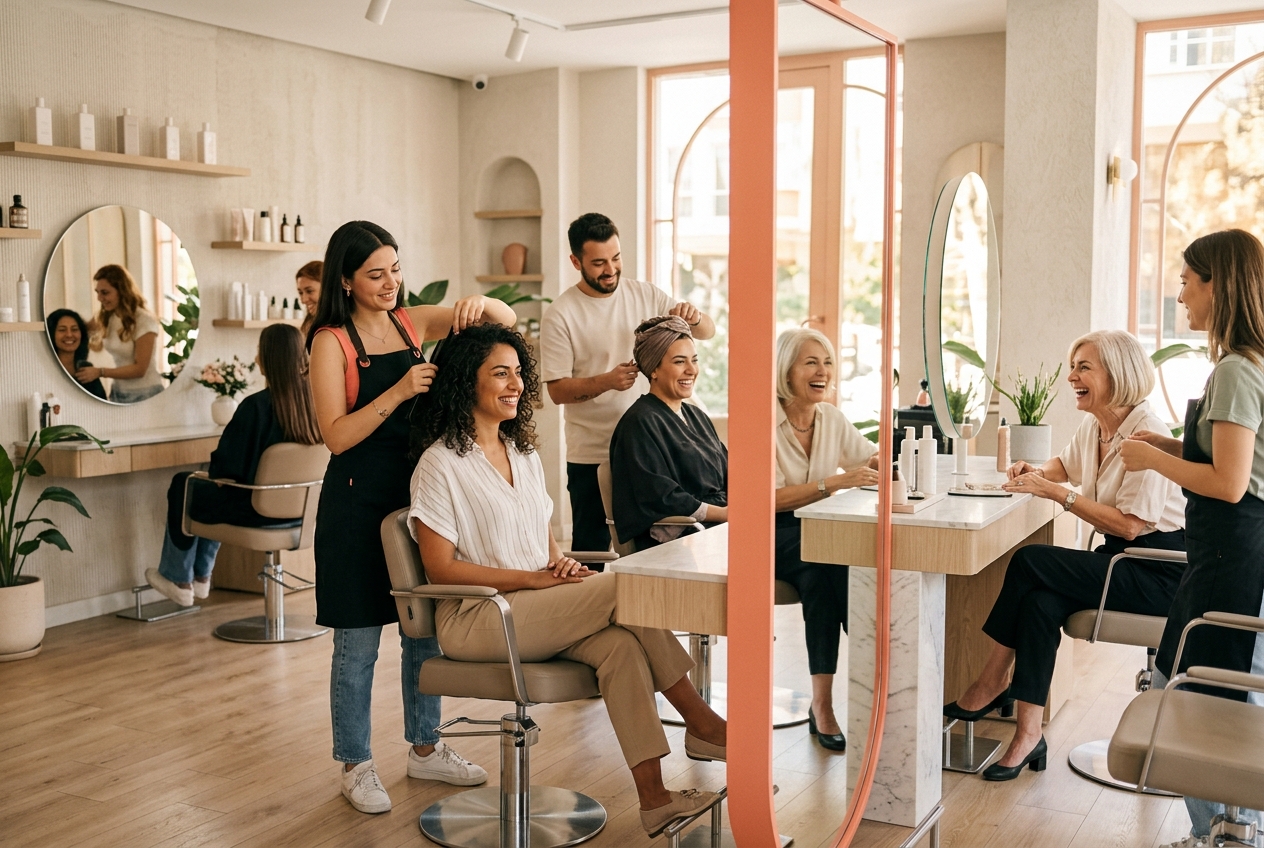
Running a salon was never just a matter of scissors and color; it has always been a people business. But over the past few years, what those people want has visibly changed. The client in your chair is no longer just after a good haircut — they're looking for an experience, a convenience, and increasingly a sense of trust. The tricky part is that this shift happens slowly and quietly — you don't wake up one morning and declare "everything's different now." Your foot traffic looks the same, but the phone rings less and the Instagram DMs pile up more; walk-ins are down while "do you have anything online?" is up.
In this piece you won't find hard numbers, made-up percentages, or "according to our study" sentences — because anyone who knows the industry knows that every salon, every neighborhood, every client base is different. Instead, we'll honestly share the trends we observe on the ground, the ones we hear again and again talking to salon owners and beauty professionals. And for each trend, we'll answer the question that really matters: so what should you, as a business, actually do?
Not long ago, online booking was a "plus" reserved for the bigger salons that knew their business. Today the trend we see is this: clients almost automatically assume your salon takes bookings online. Especially for working people who can't call during business hours, it's clear-cut — halfway through planning their evening, the moment it crosses their mind, they want to see availability on their phone and grab a slot. Every time the phone goes unanswered and someone hears "call tomorrow and we'll check," that's a silent loss.
What lies underneath this isn't impatience but habit. As people get used to arranging their food, their transport, and their cinema tickets from their phone, they expect the same ease from their salon. Failing to meet that expectation puts you in the "hassle" category even if your service is excellent. And the uncomfortable truth is: a client won't tell you that you're a hassle — they simply won't call again.
People who want to sum up what the client wants in one word usually say "speed." True, but incomplete. The trend we observe is far more subtle: clients don't want to wait, but they still value the time in the chair. In other words, they count the dead time at the door and around the appointment as a loss; but they see the time set aside for the cut, the treatment, or the conversation as an escape, a reward. Mixing the two up is the most common mistake.
In practice that means: rushing a client in and hurrying through their service isn't the solution. What's really wanted is predictability. If the appointment is at 3:00, starting at 3:00, knowing up front how long it will take, removing the uncertainty of the wait in between... that's the point where a client says "coming here is easy." The experience lies less in the luxury inside the salon and more in the smoothness of the process.
This is perhaps the strongest and least-discussed trend. Clients now hate surprises when it comes to price. Register-side surprises like "we also added this treatment" or "it took more product than expected" leave a sour taste no matter how good that day's service was. The direction we observe is clear: businesses that give a clear price, a clear duration, and a clear set of expectations win loyal clients more easily.
Honesty shows up not only in price but in advice. A stylist who can say "honestly, your hair doesn't need this treatment right now" may look like they've walked away from a sale in the short term; but in the long term they earn trust — and trust is everything in this business. The cost of losing a client once is far higher than being honest and postponing a single treatment. Transparency is no longer a virtue, it's a commercial strategy.
A new client has already "visited" you before they ever walk through your door — on Google, on Instagram, in the reviews. The trend we observe is this: clients make their choice on their screen, long before they set foot in the physical salon. That means a business's digital footprint has become at least as important as its storefront window. An outdated profile, unanswered reviews, or simply not being found — all of it quietly loses clients.
The point here isn't to become a wildly popular social media personality. The point is consistency and findability: the right address, the right opening hours, a few honest shots of your real work, and replies to incoming reviews written in a human voice. A realistic, consistent impression inspires more trust than heavily filtered photos. If your digital order is a mess, your first impression is already damaged no matter how clean your salon is.
A trend that has been quietly growing for a long time has now become too obvious to ignore: the male client's interest in grooming and regular appointments. The male client profile once seen as "comes in, gets a trim, leaves" has widened; a segment looking for skincare, beard shaping, a regular routine, and a quality experience is visibly growing. It's worth reading this not as a passing fashion wave but as a lasting change in habit.
The interesting thing about this group is how prone they are to loyalty. Once they find a place that suits them and a professional they trust, they turn into a regular, predictable client. But the same group also carries the expectations we listed above — online booking and transparency — most strongly of all. So men's grooming is growing, but winning it over is only possible by adapting to these very new habits, not by clinging to old ways.
The idea of loyalty has changed too. The stamped card and "your tenth one is free" logic used to be enough; the trend we observe today is that clients attach themselves to something far more holistic. Clients now return to the place where they feel remembered. Their name being known, what they had done last time being recalled, their preferences being noted — these build a far stronger bond than any discount.
The critical factor here is memory. In a busy salon it's humanly impossible to keep the history of hundreds of clients in your head; that's exactly why keeping client history organized has become the silent infrastructure of loyalty. Who did what and when, what they liked, what they didn't want... the business that holds this information can give every client the feeling of "I know you." And that feeling produces the kind of attachment no campaign can buy.
Look at these trends one by one and a common thread jumps out: nearly all of them revolve around order and visibility. Online booking, a predictable time plan, transparent pricing, client memory, noticing who stops coming back... none of it is solved by working harder, but by managing the work more tidily. For a business that keeps its information scattered across messy notebooks and phone memory, meeting these expectations only gets harder.
This is exactly where the right digital tool makes things easier — without deciding for you, simply by tidying up the mess in front of you. We build SalonSync with that in mind: a light, lean tool for offering the online booking clients expect, keeping appointments and client history organized in one place, and automating reminders. Our aim isn't to change the soul of the salon; it's simply to keep the owner from drowning while keeping up with these new habits. And we do it with 0% commission and a flat, predictable price — because transparency should apply as much to what we offer you as to what we recommend to your clients.
Rather than pitting the two against each other, you need to balance them. The trend we see is this: clients don't want needless waiting or uncertainty, but they still value the quality time spent on the service itself. What they're really after is predictability — the appointment starting on time and knowing up front how long it will take. Speed doesn't mean cutting the experience short; it means removing the dead time and the guesswork.
Regardless of salon size, the client's expectation of online booking is steadily becoming an assumption. For small salons this can actually be an advantage, because for a business without staff to answer the phone all day, online booking keeps you from quietly losing requests that come in after hours. It's not about looking big; it's about being reachable.
The trend we see points the other way. Surprises at the register erode trust no matter how good the service was. Giving a clear price and duration up front doesn't weaken you; on the contrary, it earns loyalty through the feeling of "they won't blindside me here." Transparency looks less like a short-term risk and more like a long-term investment.
We're seeing the male client profile widen and shift toward regular grooming. The most concrete thing you can do is clearly define the services and durations aimed at this group, make online booking easy, and encourage regularly spaced appointments. This group is prone to loyalty, but their expectations of transparency and convenience are high too; you win them not with old-school habits but by adapting to the new ones.
We build SalonSync as a light tool that organizes the salon's work rather than changing it. It makes it easy to offer the online booking clients expect, keep appointments and client history in one place, and automate reminders. The goal is to help the owner keep up with these new habits without being overwhelmed — and to do so with 0% commission and flat pricing, staying true to the very transparency we recommend.
SalonSync is in early access: a free plan, 0% commission, and a flat, predictable price. Bring your online booking and digital order together in one place, without breaking the soul of your salon.