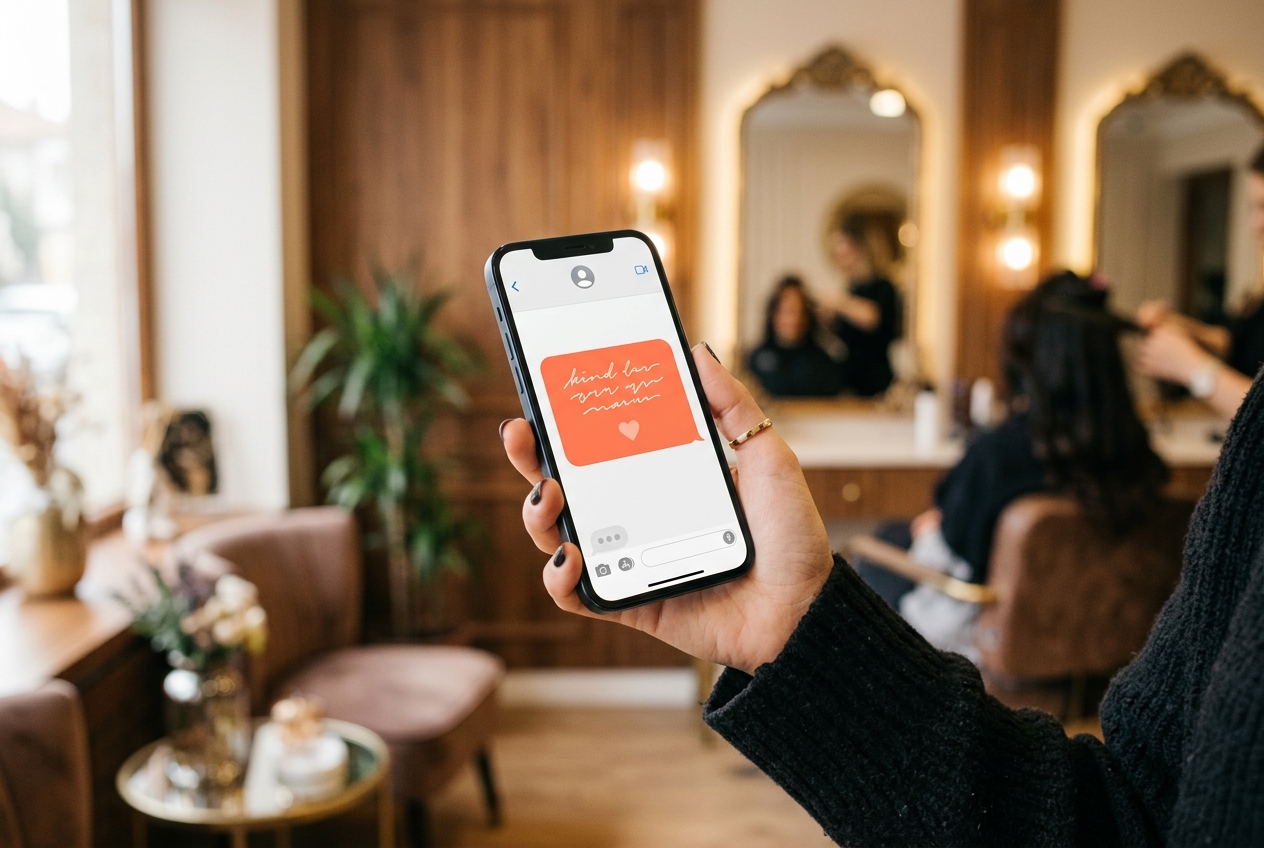
Every salon has that one client. They came in for months without ever missing a beat, sat in your chair for hours, drank their coffee, shared their news. Then one day they stopped. A week, two weeks, and before you knew it months had gone by. And in the back of your mind the same question keeps circling: Did we say something? Did we upset them? Or did life just get busy and they simply forgot?
This article is for exactly that dilemma. For the nagging "are they upset or did they just forget?" question, we'll show you how to reach out without crowding or bothering your client — complete with ready-to-use copy-paste message templates. No fluffy theory; just concrete things you can pick up your phone and put into practice tomorrow.
This is the biggest false assumption in most salon owners' heads: if a client isn't coming back, we must have done something wrong. Yet the truth is usually far more ordinary. People's lives change. They move, work gets hectic, money gets tight, they relocate to another city, or they simply forget to book that next appointment and don't notice months slipping by.
The answer to the "are they upset or did they just forget?" dilemma, in the overwhelming majority of cases, lands firmly on the forgot side. A client who is genuinely upset tends to make it known — they'll either tell you to your face or never walk past your street again. But the client who quietly disappears hasn't gone because they stopped thinking of you; they've gone because they kept putting off booking amid the daily rush.
So our first rule is this: don't approach them like they're guilty. Lines like "Why did you leave us?" or "I guess you're upset with us" push the other person onto the defensive and conjure up a problem that was never there. Your job isn't to interrogate — it's simply to leave the door ajar.
The line between following up with a client and pestering them is thin, and what defines it is frequency. One reminder message is gracious; three messages in a row are irritating and drive the client away for good.
A healthy rhythm might look like this: think about the client's normal visit interval. Someone who comes in every month and has now let two months pass, or someone who colors their hair and has gone past the six-to-eight-week mark — that person has now moved into the "lapsed client" category. That's exactly the point, once they've slightly overshot their natural interval, to send the first gentle message.
If there's no reply to that first message, don't insist. A month or two later, if you have a concrete excuse in hand — a new promotion, a birthday, a change of season — you can remind them once more. But firing off more than one unanswered message a month to the same person turns your good intentions into a nuisance.
The safest place to start is a check-in note that carries no pressure at all — one that simply says "you're on our minds." The goal isn't to make a sale; it's to reconnect the thread. Use their name, be warm, keep it short.
Soften the templates below into your own voice; they should sound like the way you talk, not like a script read verbatim. Fill in the brackets with your own details.
If the neutral message goes unanswered, or you'd like to give the client a little nudge, a modest incentive works well. The thing to watch here is to present the incentive not as a "favor" but as a sincere invitation. Rather than over-the-top discount promises, small gestures that make the person feel special are far more effective.
Decide what to offer based on your own margins — a little something extra at their next visit, an added touch-up, or simply a convenient time slot. What matters is the tone of the message: unforced and inviting.
The birthday message is the most gracious of all win-back tools, because it's entirely sincere; it carries no whiff of a sales pitch. The client feels that you remembered them, that you don't see them as just a row of data. Even for someone who hasn't been back in months, this is the most natural ice-breaker there is.
Send a simple congratulations if you like, or tuck a small invitation onto the end. Both work, as long as you don't overdo it.
All of this sounds lovely, but there's no way to track, on your own, which of hundreds of clients came in when and who hasn't been by in months. In a notebook, in your head, or in scattered WhatsApp threads, that information gets lost. The client you call "hasn't been back in months" is usually one you only notice by chance.
This is precisely where SalonSync earns its keep. Looking at appointment history, the system pulls up a report like "clients who haven't been back in the last 6 months" with a single click. You see who's been away for a long time by trusting the record rather than your memory. You can grab that list and send a bulk reminder over WhatsApp using one of the templates above — each one a minute's work.
What's more, the system remembers recurring opportunities like birthdays for you. That way the "did we upset them?" worry turns into a concrete list in your hands and a steady habit. And because appointment and client tracking in SalonSync starts out with 0% commission, flat pricing and a free plan, this win-back discipline adds no extra burden.
Not if the tone is right. A message that interrogates, blames or pressures will annoy; but a short, warm "you've been on our minds" note pleases most people. People like being remembered. The key is to send a single message and not to keep pushing if there's no reply.
The best message for an upset client is a neutral reminder that doesn't get defensive and leaves the door open. Inviting them warmly, without questioning why they left, usually breaks the ice. If they still don't come, don't force it; you can't win everyone back, and that's normal.
Tracking it by hand isn't practical, because the more clients you have, the harder it is to remember who came when. A system like SalonSync looks at appointment history and automatically produces a "clients who haven't been back in the last 6 months" list. So instead of guessing who to reach out to, you know from the record.
Use each client's own normal visit interval as your reference. Send the first gentle message once they've slightly overshot that interval. If there's no reply, wait a month or two and let your second contact have a concrete excuse, like a birthday or a promotion. Sending more than one unanswered message a month to the same person crosses into pushy territory.
Join early access with SalonSync's "haven't been back in X months" report and WhatsApp reminders — 0% commission, flat pricing, free plan.